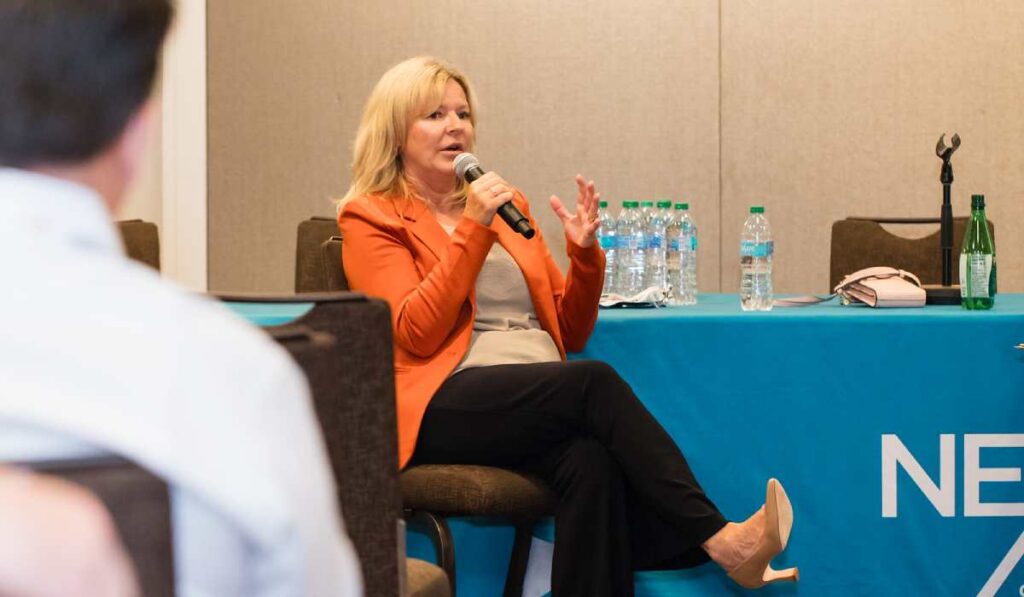
Anita Adams shared insights during a Fireside Chat at last year’s NextGen Restaurant Summit, hosted by FSR in Atlanta.
FSR
How Anita Adams is Protecting Black Bear Diner’s Legacy While Scaling
By Callie Evergreen
September 1, 2024
The CEO of the 160-unit NextGen Casual brand shares her insights on franchise-focused expansion, investing in people and partnerships, navigating regulations and labor challenges, and more.
When Anita Adams stepped in as CEO of Black Bear Diner in January 2020, it was the first transition of leadership from Bruce Dean and Bob Manley, who co-founded the brand in 1995 in Mt. Shasta, California. “These two amazing gentlemen had created this brand, and it was their legacy, and it mattered to our franchise partners that Bruce and Bob had a face in this. It matters to our team members,” Adams told audience members at FSR’s second NextGen Restaurant Summit earlier this month. “So we’ve held onto that, and there’s a little ego check at the door. But it’s a really great brand—it just needed the infrastructure to scale, a little more professionalism in areas.”
Prior to joining Black Bear Diner in 2017, Adams served eight years as the chief financial officer at American Blue Ribbon Holdings—the parent company of Village Inn, Bakers Square, O’Charley’s, and more—and was part of the executive team that grew the business from $400 million in revenue to $1.2 billion.
With Black Bear Diner receiving private equity backing from GreyLion in 2016 (called PWP Growth Equity at the time), she knew the company needed to shore up its operational and financial foundations to support ambitious growth plans. But she was adamant about not losing the essence of what makes Black Bear Diner special. The cabin-themed diners feature carved bears, photos of mountains everywhere, and a menu printed in a newspaper-style format that shares the story of Black Bear Diner.
“I felt like it was really just taking and protecting the heritage of that, and what was unique about Black Bear and separating that piece from the scaling. We didn’t want to change who we are,” Adams emphasized. “Culture is just key in this.”
When Adams was elevated to CEO four years ago, Black Bear Diner stood at 138 locations and was on the cusp of celebrating its 25th anniversary. Now, the diner chain stands at 160 restaurants with dreams of reaching 800 stores nationwide someday.
Adams’ growth strategy is focused on developing and building out markets, rather than opening units scattered across the country. “Having orphan restaurants or diners in disparate locations is really difficult to support,” she noted.
The brand has opened six diners so far this year, with a goal of opening 15 total, including five company-owned stores in Texas (San Antonio, Dallas, Houston, and Rio Grande Valley). Another five restaurants will open in the state in early 2025, and the brand believes there’s room for 50-plus diners. “We’ve been all in on Texas,” Adams said.
With 34 franchise partners who own 90 locations, taking a collaborative approach is paramount. “We are growing alongside of our franchise partners. I think that’s another important component. I know different brands have different views on that,” Adams said. “But if I’m going to ask you to write a check for a couple million dollars to invest, I’m doing it right alongside of you.”
The brand also takes advantage of second-generation opportunities, endcaps, freestanding spots, and even travel centers, which can bring in a lot of volume. In 2019, 30 diners earned more than $3 million in annual sales; in 2023, that figure rose to nearly 55 diners. Corporate AUV hovers around $2.8 million.
Adams warned NextGen Summit attendees about giving away too much territory to franchisees, sharing her learnings from having to unwind a couple larger multi-unit deals that didn’t end up getting done. “If they can’t execute, it’s really good for no one,” she said. “We did unwind a couple of those, where they just really didn’t have the capacity to grow that way … You want people to execute on what they’re signing up for. Creating those territories, particularly where you have multiple franchisees in similar geography, you want to be very careful about that.”
With the brand’s heavy footprint in California, Adams also touched on some of the unique challenges in operating in a state with more industry regulations. “There’s 39 million people. That’s a lot of guests. And we have some of our most profitable diners in the state of California. We live there, we work there,” she said. “Once you know and understand how to operate in the state of California, it can be very lucrative.”
Adams continued, “It’s really ensuring you’ve got really strong legal representation and partners who can help guide you through all of this … Not to say we don’t have some employment matters here and there, but we stay out of harm’s way because we run our business the way we should. And once again, we’re seeped in this culture piece. We think culture actually mitigates a lot of legal exposure when you are a great employer and you provide avenues for people to raise their hand. We always try to get in front of things and talk it through before we get the legal letter.”
Buttoning up the company’s HR practices has been key to this, in addition to beefing up training programs and building a collaborative working environment.
Adams is “really just making sure we’re very disciplined on the growth side of this and having a very clear strategy around where we want to be, and really the people side of it, too,” she added. “How do you ensure that we keep that people pipeline, that we surround ourselves with people who believe in this brand the way we do, and that’s the hardest part, is ensuring you’ve got enough folks that are all on the same bus.”
